Studio
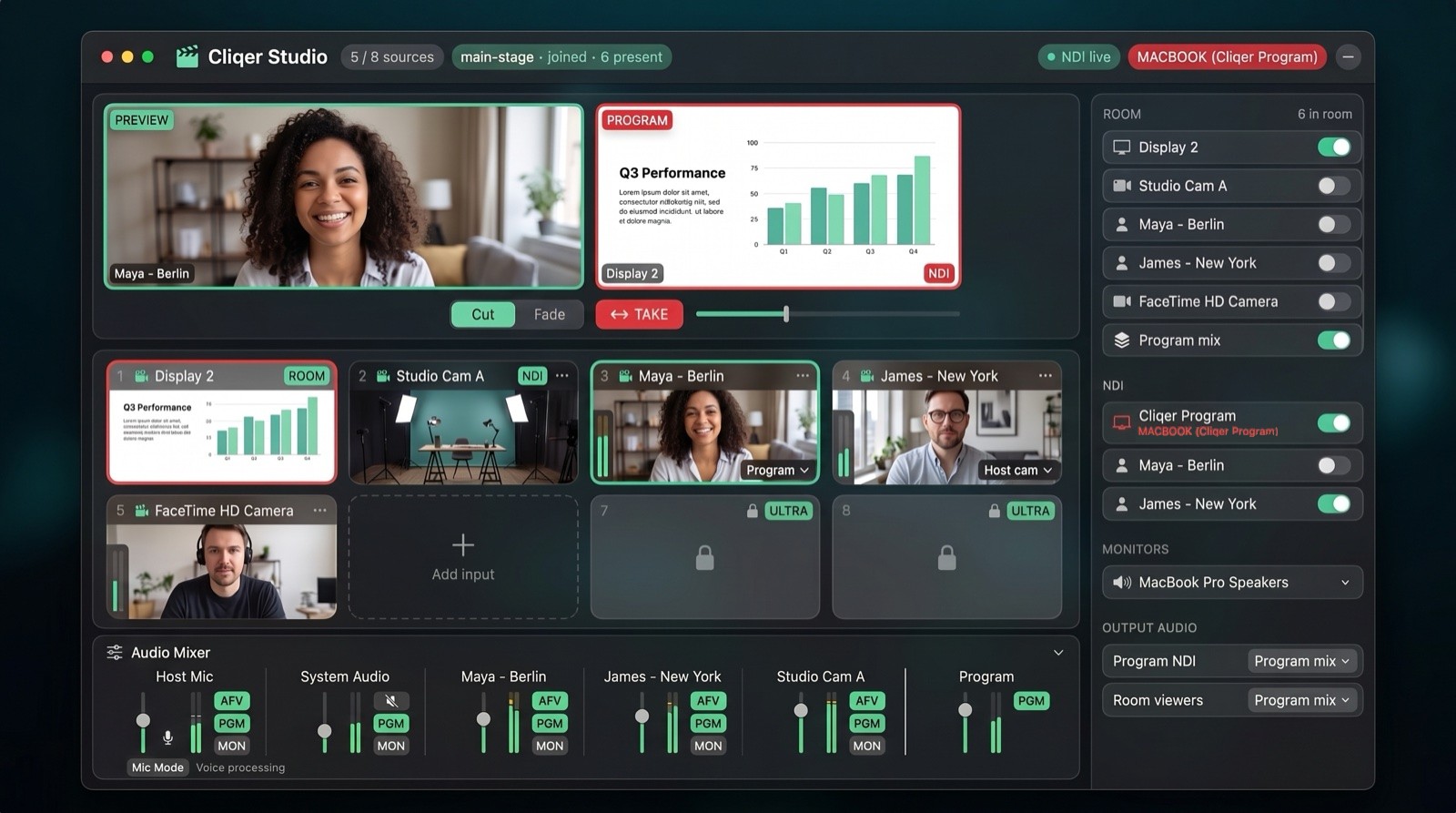
Cliqer Studio turns the desktop app into a compact vision mixer. Displays, cameras, NDI® sources and remote callers all become inputs on one rack. You stage them on Preview, cut or fade them to Program, and route the result where you need it: to the people in your room, to your production software over NDI, or both.
Open it from the people icon in the desktop app toolbar (tooltip Studio) while you are hosting a room. The window is titled Cliqer Studio, and its header shows the room, whether Studio has joined, how many people are present, how many sources you are using against your plan, and the state of the Program NDI output. The minus button hides the window again without ending anything.
Studio joins your room as a mixer, not as a participant: it never shows up in your presenter list and never uses one of your room's presenter places.
Preview and Program
The deck at the top is a standard two bus switcher.
- Preview (green) is what you have staged next.
- Program (red) is what is live. It shows the composited program mix, so a dissolve looks the same here as it does on air.
- Click any tile to stage it on Preview. Double-click puts it straight on air.
- On hover, each tile also has PVW and PGM buttons. Those are toggles: clicking the one that is already lit clears that bus.
- TAKE swaps Preview and Program with the selected transition: Cut (instant) or Fade (a half second dissolve).
- The slider beside TAKE is a T-bar. Drag it to the far end to complete the transition; the buses swap there and the program output cuts at that point rather than following your hand.
- Program NDI on the Program monitor sends the program mix to the network. The same switch appears in the outputs rail.
Inputs
The rack below the deck is a fixed grid of bays. Filled bays are your inputs, empty bays inside your plan are Add input cards, and bays past your plan show a padlock with the plan that would open them.
Add input has four tabs:
| Tab | What it adds |
|---|---|
| Screens | One of your displays, with a live thumbnail while you choose. |
| NDI | Any NDI source discovered on your network, with a live thumbnail. Cliqer outputs on the network are filtered out, so you cannot feed the mixer its own program. |
| People | A presenter already in your room, invited onto a call. See Callers. |
| Camera | A camera attached to this computer. One camera input at a time; picking another replaces it. |
Adding a source closes the picker so you can see the tile land on the rack. An add that your plan refuses keeps the picker open and tells you why.
Each tile carries its rack number, its name, a Room badge when it is the room's live source, an NDI button, and a close button (a red handset for callers, which disconnects them). Until a source has produced its first frame the tile shows Connecting, so a bay is never just an empty rectangle. A red ring means the input is on Program, a green ring means Preview.
Hovering a tile also exposes a fit / fill button. The program canvas is a fixed 16:9, so fit letterboxes the input into it (the default) and fill scales it to cover and centre crops it. This affects the program mix only; the room and monitor legs follow each source's own shape.
Removing an input releases the source, so removing a camera input turns its indicator light off unless a caller return feed is still using it as Host cam.
Outputs
The right hand rail is the router. Nothing goes to air by itself: every output here is an explicit switch.
- Room: a switch per input sends that source to everyone in your room. Displays and NDI sources can take the room slot, and there is one room slot at a time, so arming one moves it off the previous input. Callers and the host camera cannot be routed to the room yet; their switches are disabled and say so.
- Program mix: routes the whole Program bus to the room as its own stream, so your audience follows your cuts and fades. The same output appears as Program (Studio) in the desktop app's screen picker.
- NDI: the Cliqer Program switch broadcasts the program mix, with its advertised name shown underneath. Below it, a switch per caller exposes that caller on their own NDI source. Displays, cameras and relayed NDI inputs get the same per input NDI button on their tile.
- Monitors: which audio output device you listen to the monitor mix on.
- Output audio: which mix each output carries. Program NDI and Room viewers can each carry the Program mix, the Monitor mix, or Silent.
NDI sources Cliqer advertises:
| NDI source | Content |
|---|---|
Cliqer Program | The Program bus, video with the program audio mix |
Cliqer Caller - <name> <id> | One per caller: their camera and microphone |
Cliqer <input name> | One per display, camera or relayed NDI input you switch on |
Your computer's name prefixes all of them on the network, so they list as MACHINE (Cliqer Program) in vMix or OBS. See NDI Output and vMix: Callers as NDI Sources.
A Stream Deck can take any rack input to Program, toggle an input's room output, or cut the Program bus to black while Studio is open.
Audio mixer
The Audio Mixer panel at the bottom of the window opens and closes on click, and remembers which way you left it. Audio is mixed by the desktop app itself, not in a browser tab.
There is a strip for Host Mic, one for System Audio, one per caller (named after the caller), one per NDI source, and a read only Program master. Every strip except the Program master has a fader (0 to 200%), a mute, live meters, and two bus buttons:
- PGM, the program bus: what goes to air, embedded in the
Cliqer ProgramNDI source and in caller return feeds. - MON, the monitor bus: what you hear locally, without changing the broadcast mix.
Caller and NDI strips also have AFV (audio follows video), which is on by default for both: the strip follows the program bus and its fader visibly dims as it ducks through a crossfade.
Echo cancellation is applied to your own microphone inside the desktop app's audio engine, so open speakers do not feed back into the show. The readout under the strips names the mode in use; on macOS a Mic Mode button opens the system microphone picker.
Fader, mute and bus routing are remembered between sessions for Host Mic and System Audio. Caller and NDI strips exist for as long as their source does.
Callers
Callers are remote guests who send camera and microphone into your production. They need nothing but a browser, on any device, and they join your room from the normal presenter link.
Inviting
- Open Add input and pick the People tab. It lists everyone in your room who is not already on the call.
- Click Invite. Their browser asks for camera and microphone.
- The tile appears on your rack, shows Connecting until their first frame arrives, then behaves like any other input: click to stage, double-click to air, NDI button to send them out on their own source.
The red handset on the tile disconnects a caller.
What the guest sees
A compact panel appears in the corner of the presenter view:
- The return feed you routed to them, labelled Program, Preview, Host or No return feed.
- A small self preview.
- Camera and microphone toggles, and a Leave button.
- Camera and microphone pickers, which switch device live without dropping the call.
If their browser blocks audio that starts without a tap (Safari in particular), the panel shows a Tap for audio button. One tap unblocks it.
Capacity
Every input on the rack counts as one source, and callers are sources too, so the two caps interact: a display and an NDI feed on a Pro plan leave room for two callers, not three.
| Plan | Studio sources | Caller video sources | NDI inputs |
|---|---|---|---|
| Free | 1 | 1 | 1 |
| Pro | 4 | 3 | Unlimited |
| Ultra | 8 | 9 | Unlimited |
| Studio | 16 | 16 | Unlimited |
| Enterprise | 20 | 16 | Unlimited |
| People watching or clicking in your room are not sources and never count against these. Callers do take one of your room's presenter places as well, because they join the room before they join the call. Sixteen callers at once is the hardware ceiling regardless of plan. |
These caps are enforced on our servers, not only in the app: a caller over the limit is refused with a plain explanation, and the host is told which cap was hit so they can free a bay or upgrade. Clicking a padlocked bay opens the same summary and hands off to the plan page in your browser.
Return audio and video
Every caller hears the program mix minus their own microphone, computed per caller, so they hear you and each other but never an echo of themselves, however many callers are live.
What each caller sees is chosen per caller from the selector on their tile:
| Return feed | The caller sees |
|---|---|
| No return | Nothing, audio only |
| Program | The live Program bus |
| Preview | The Preview bus, useful for cueing a guest before they go live |
| Host cam | Your own camera input |
Connection and security
Each caller gets a dedicated, encrypted peer connection for media, separate from the channel that carries slide control, so cueing slides never competes with caller video. Connections traverse firewalls with STUN and fall back to a relay when a direct path is blocked; media is always encrypted with DTLS-SRTP. Network requirements are the same as the rest of Cliqer, see Security & Networking.
Restarting the app
Studio remembers the shape of your rack, never what was on air.
Comes back after a restart:
- Your display, camera and NDI inputs, and each input's fit or fill setting.
- The Cliqer Program NDI switch, in the state you left it.
Does not come back:
- Program and Preview are empty. A stored take never re-airs itself.
- Every Room route is off, including Program mix to the room. Going on air is always a deliberate action in the current session.
- Callers are gone. A caller is a live session, not a saved input, so callers rejoin by invitation.
Troubleshooting
Add or Invite is greyed out
You are at your plan's source cap, or, for Invite, its caller cap. The message under the list names the source cap when that is what you hit. Remove an input, or click a padlocked bay to see what a higher plan opens.
A caller could not join
The room's plan ran out of caller places or out of rack space. The guest sees the reason, and you get a notice naming the cap that was hit.
Nothing shows up in vMix or OBS
- Check the pill in the Studio header. NDI off means the NDI runtime is not installed on this computer, NDI ready means it is available but the Program output is switched off, NDI live means the program mix is going out.
- Check the per input NDI button on the tile you expected.
- The advertised name is shown beside the pill and in the outputs rail; look for it under your computer's name.
- Your production machine has to be on the same network segment, see NDI Output.
A tile says Connecting, or stays dark
Connecting clears the moment real frames arrive, so a tile that stays there is waiting on the source: a guest still granting camera permission, or an NDI sender that has stopped producing. A live caller who has muted their camera keeps sending black; their tile stays dark while their audio and meter keep running.
Caller video looks soft
Caller quality is bound by the guest's uplink. Under congestion their browser trades some resolution to keep the motion alive and recovers when the pressure clears. Ask them to close other video apps or move closer to their router.
"Screen inputs need a desktop app update"
Your desktop app predates native display and camera inputs. Update it, and the Screens and Camera tabs become live.
"Camera access is blocked"
Allow the camera for Cliqer in your system privacy settings, then reopen the Studio window.
See also: